Showing posts with label Europe 2015. Show all posts

Thursday, 29 December 2016

Dresden Day 1: Neustadt and Semperoper

Exams and Christmas are over, and I'm back! For now, here's another tale from Tristan's and my time in Europe in the summer of 2015.

When we decided to go to Dresden, I was adamant about one thing: I really, really, wanted to stay in the Neustadt (New Town). As it turned out, all the hostels in Dresden are located in the Neustadt…and as it further turned out, all were already booked. Oops (we’ll learn one day, I promise!).

Wednesday, 10 August 2016

Old Building, Old Libraries: Day 2 in Prague

I had some serious formatting issues - thanks a ton, Blogger - while making this post. This is version 2.0, and I think/hope they're fixed now, but if you see more text or pictures bunched together in a way that makes no sense, please let me know!
Picture credit to Tristan.

Wednesday, 22 June 2016

Prague: Day 1

After my post on Montreal a few days ago, I've jumped back to last year's Europe trip for this post. From the Saxony Switzerland region in Germany, which I posted about before Montreal, we hopped on a train and went onwards to Prague.


Oh my goodness, Prague. Where do I even begin to describe Prague? It was beautiful, amazing, touristy, wild, crazy, shocking…

That last point began even on the train ride there. Oftentimes, when you cross a country border, there is little or no change (think of the US-Canada border. If not for the border control – of course – you’d never know you were suddenly in a different country). Not so with the Germany-Czech border. Tristan and I spent quite a while discussing what, exactly, the difference was, and weren’t able to really put a finger on it.

I think the difference can be summed up with this: the Czech side of the border looks less nice. Whereas the German side had been pristine, with sweet little villages of red-roofed brick or half-timber houses in marvelous condition surrounded by green forest, the Czech side had factories, supermarkets, cargo barges on the river (and thus freight harbors), ugly new apartment blocks surrounding those same little villages – and also, as far as I could see, much more decay than Germany. Tristan summed it up well later when he said it looked distinctly Eastern European, which neither of us had seen before.

To be clear: I attach no judgment to this. I do, after all, come from North America, and I’d say the towns looked no worse and quite possibly better than your average North American town. As well, the Sächsische Schweiz is one of the nicest and most pristine area of Germany I’ve seen; it’s not like the country doesn’t have its own big cities and industrial areas (if you know anything about Germany’s economy, you’ll know it’s more like the opposite…)

Anyways, the sudden and unexpected change, as well as a large influx of people onto the train as soon as we crossed the border, and a language barrier, and we found ourselves mildly culture-shocked.

Thankfully that feeling didn’t last, and the next morning found us ready to explore the beautiful city. First stop? Being massive tourists and visiting Prague castle.

The castle is HUGE. I’ve been in and around quite a few European castles and none that I can remember compare to the sheer size of this one. We got lost in the gardens just trying to find the entrance. Not that we minded, since they’re beautiful and provide lovely views of the cathedral and other castle buildings!


Saturday, 4 June 2016

Saxony Switzerland Day 2: Castles and Camping Mishaps

In my first post about this region of Germany, I talked about our hiking mishaps. The post ended when we made it to our campground, but unfortunately our mishaps did not.

Mainly, we were out of food.

So, being millennials, we googled “supermarkets in Hohnstein” and found one that would be open until 10 pm. As it was around or even past 9 pm at this point, we raced off onto the approximately 20-minute walk into Hohnstein proper, despite being exhausted, sore, and hungry.

20 minutes later, we found ourselves in Hohnstein. But we didn’t see the turn off we were looking for. So we kept walking…and walking…We finally asked someone, only to be told that there were no supermarkets in Hohnstein. The next closest was a good couple minutes’ drive away, too far to walk easily, and busses were not running anymore…and wouldn’t be running over the weekend. Big sigh. There was a little convenience store-type of place that would be open over the weekend, but was closed for the day. Another sigh. (I’m not totally sure how this happened, but Germans often use similar names for different towns, usually with a prefix or suffix, or hyphenated with another name, so it’s possible that google showed us a different town with the same name instead. Or something).

We were obviously some very unhappy campers at this point (literally! Am I not hilarious?). Thankfully, the campground offered a daily Brötchenservice (bun delivery service), since Germans can’t be asked to live without freshly-bakes buns for breakfast, no matter how much they’re roughing it. This service amused us to no end (I’m not exaggerating the importance of fresh Brötchen), but ended up being our saving grace. We ordered enough buns to last us for the day and cobbled together a dinner out of the food we had left. Another saving grace: the sunny day turned into a beautifully clear night sky that we got to admire before bed.

Now, this wasn’t the end of the mishaps…when setting up the tent, a tent peg was missing, even though I could have sworn there were enough when we left. We bought new ones in Hohnstein the next day, but all they had was an entire package (no single ones), that was expensive, and the tent pegs sucked. They still elicit the occasional curse on camping trips. Then there was the chocolate that melted…all over my backpack’s lid pocket…and then we went to town (more on that in a second) and though we were done with mishaps.

Unfortunately, once back in our campground, we realized that our mishaps were not over yet. Tristan had put his bar of soap onto my hiking boots in order to keep it off of the ground, but the soap had disappeared. I reached into the boot to see if the bar of soap had slipped in – and in lieu of a bar of soap, I felt a strange, hard layer where my insole should be. Tristan’s soap hadn’t slid into my boot; it had melted into my boot. I was fuming. I was afraid that my boot was ruined – I’d only purchased them last year and hadn’t used them much since., so they were nearly new at the time. Poor Tristan of course felt bad about the shoe and was also disappointed about the loss of a nearly new bar of soap (it was Lush soap too, so you really can’t fault the guy!). My worries, at least, were unfounded: most the soap just peeled out, and most of the residue that was left behind subsequently rinsed easily out of the insole. It became a standing joke that at least one of my feet would not only never smell badly, but would smell of Lush.

Hohnstein


The morning after our first night of camping dawned even hotter than the previous day (35°C!!!). Between that and our very sore legs (and my sunburn…Tristan of course doesn’t ever burn, sigh) we decided against hiking and went to explore the village instead.

This turned out to be an excellent choice.
Photo by Tristan
 Hohnstein is a really cute, largely medieval town set on essentially the edge of a mountain, overlooking a fairly steep and narrow valley (the one we hiked through on our last day). This gives the town an interesting look, as houses are placed at drastically different levels, and many of the streets run steeply downhill. That also made it interesting (if tiring on the legs!) to explore.

Both by Tristan
Towering above the town is the eponymous castle, which was somewhat obviously our main destination in the town.

But first, a coffee/ice cream break.
No pictures of the food this time, but this was the view from the cafe. Also Tristan's wearing my sunglasses.
The castle is well preserved mainly thanks to the fact that, unlike most castles in Europe, it was in use for most of its life. Once it was no longer needed for its original purpose (defense) nor used as a main residence, it was maintained as a hunting lodge for the rulers of the region. Later on, it served as a prison and the seat of justice for the region before becoming a youth camp and hostel. When the Nazis took over the castle, they made use of the dungeons and defensible position left over from its previous purposes and turned it (sadly) into a concentration camp. In the Second World War the castle was used as a POW camp; towards the end of the war it was turned into a refugee camp for Germans and German speaking people fleeing from the East (particularly what is now the Czech Republic). Nowadays, the castle has been restored to its pre-WWI purpose and serves as a hotel and youth hostel.
Another castle wall.
While the majority of the castle’s rooms are given over to its main purpose, a few of the rooms are little museums you can visit. These rooms include two dungeons; one has a (slightly disturbing) exhibit on medieval justice, while the other contains several memorials to people who were imprisoned (some in that very room) and killed at the castle during its time as a concentration camp.


There is also a little museum containing a number of artifacts found at the castle over the years, as well as its history and information on what life might have been like there in medieval times. This kind of thing is fairly typical for castles (although most castles I’ve been to don’t have quite this colourful a history!), but I found this a particularly nice little museum. I particularly like this little guy:
I did promise you guys more dragons
You can also climb the old tower, which we of course did. You get lovely views over the adjacent valley and the surrounding countryside.
The tower
Tristan on the tower's spiral staircase
Old weapons on display, near the base of the tower.
Surrounding the castle is a garden and some small paths. Particularly striking is one that leads to a viewpoint over a steep cliff.
The gate leading to the garden (with teeny Tristan in the background)

The viewpoint
The views were certainly lovely, but what made the viewpoint striking was a small memorial plaque. During the time the castle was a concentration camp, the Nazis forced several prisoners to run at and over the cliffs to their deaths.

A general memorial to the time of the Nazis and the Second World War stands just outside the entrance to the castle. I’ve never seen a memorial quite like this one, so I found it very interesting from an architectural standpoint (my dad told me later that it’s actually very typical for socialist-era memorials in Germany, but oh well. It looks to my untrained eye like it might be an example of Soviet Brutalist architecture, any knowledgeable folks care to weigh in?). The inscription translates roughly to “as a reminder and warning for the living”.


We had a small lunch in the castle’s restaurant too, which was really cute, and with really good “home-cooked” food. The restaurant sold locally-made Leberwurst (liverwurst sausage), which Tristan bought a glass of and loved so much he promptly ate all of it on our hike the next day. We went back after the hike to buy more, much to the amusement of the restaurant staff. For myself, I found a locally-made cheese in a little artisanal/”natural” foods-type store that I also went and bought more of the next day.
The cheese store (photo by Tristan)

Castle stay


We had been jokingly tossing around the idea of staying in the castle while walking around there, but were convinced that it would be too expensive for us. To our surprise, this was not the case, so a decision was made and a room booked for the next night (Sunday to Monday).

Sunday was the day we hiked from Bastei to Hohnstein. We got to the castle around 9 am (we had been told that checkout wasn't until 10 am but we'd be able to store our luggage) and checked in. The staff was apologetic about the fact that they didn't yet have a room for us! They gave us keys to a locked room we could put our bags and promised they'd have a room ready for us ASAP. Meanwhile we went off on our hike.

When we got back to our room, this is what greeted us in our room:

And this was the view from our room (no big deal or anything!):
Both pictures by Tristan
The room itself was a fairly average hotel room (both the beds and the bathroom were nicer than normal, however!), but this isn't a bad thing, and the setting of course is more than worth it. We payed around 75 euros in total for the double room, and dorms are even cheaper, which is very reasonable when you, again, consider the location. Breakfast is included, and I can easily say it was the best breakfast we had all trip! The staff, too, went out of their way to be kind and accommodating to us. Unlike our first night in Erfurt, where we paid nearly as much for a hostel, this was definitely money well spent.

Wednesday, 25 May 2016

Like Hiking Through a Fairy Tale: Pictures of the Saxony Switzerland

I've decided to mix up the order of the Saxon Switzerland posts, as I've been frantically writing an essay (that's due today *coughs*). My last post was day 1, and this post is day 3 of our time in the Saxon Switzerland. I'll be writing about day 2 hopefully next week.

The hike we did on the third day was a continuation of the hike we'd started on our first day. If you recall, we'd planned to hike from Stadt Wehlen all the way to Hohnstein, but ended up cutting the hike short in Rathen instead. This time, we took the bus back to Bastei and then continued the hike from there (we really didn't mind another opportunity to admire the Bastei bridge!).

Mist over the rocks near Bastei. Hard to capture with a camera, so please forgive the quality!
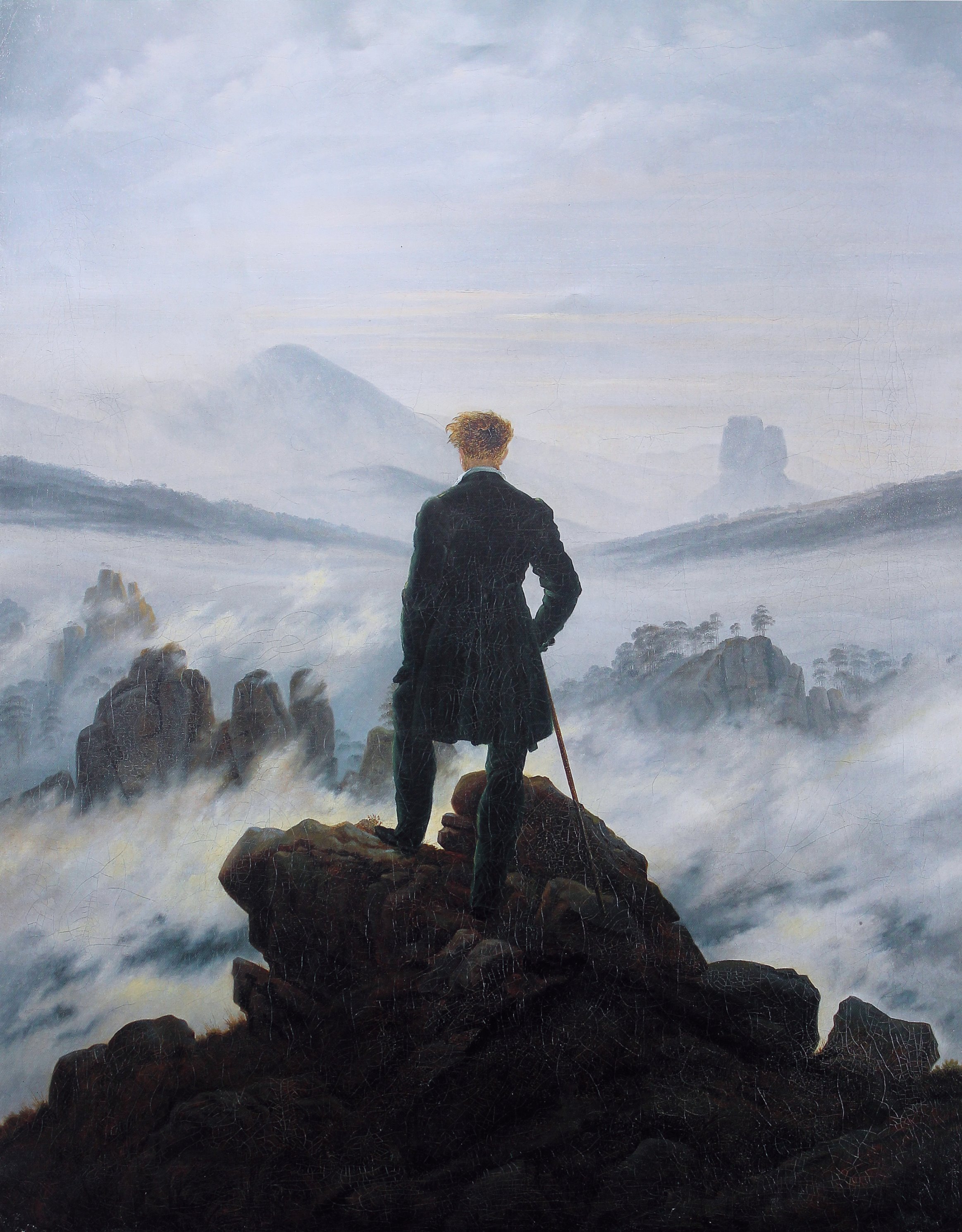
It had rained the night before, so there was mist rising as we started the hike. The mists in this region are famous - the painters I talked about last time loved them, as I'm sure you can imagine.

Mists or not, I'd argue that this section was the most beautiful one of the hike. We also loved that it was quite varied, from Bastei through to different valleys and over the heights in between. I'm sure you'll agree as you look through the pictures :). Since all the pictures make the post long, you'll find the remainder behind the cut.

Mist as seen from the Bastei bridge.

Wednesday, 18 May 2016

Saxony Switzerland Day 1: Hiking Bastei, and Hiking Mishaps

From Erfurt we went on to the Sächsiche Schweiz (Saxon Switzerland), a nature region and national park to the far east of Germany, near Dresden (it continues on over the Czech border as well, as the Bohemian Switzerland). The area is known for its sheer sandstone cliffs, which makes it very popular with climbers. It’s also really picturesque, and has excellent hiking, so it attracts all kinds of tourism.
One of the views form close to the Bastei bridge.
 When we were planning this trip, this one of the first spots that came up, due to Tristan having seen a single picture of the region and deciding he had to go there.

Specifically, the picture he saw was of the Bastei Bridge:
The Bastei Bridge. Can you really blame Tristan?
The bridge is on a multi-day hiking trail aptly named Malerweg (Painter’s trail). The trail (purportedly) follows the footsteps of the 19th-century German Romantic painters, many of whom painted (and made prints) in and of the surrounding region.
I'm sure you can understand why the painters loved this area.
Our goal was to spend two nights on the trail, hiking from town to town before heading on to Prague. We decided to start with stage 2 (according to the tourism website for the region), which leads from Stadt Wehlen on the river up to the village of Hohnstein, passing over the Bastei bridge and by the spa town of Rathen.

At the start of the hike.
Your not-quite-so-photogenic author after a while hiking in the heat and with the heavy backpack.
Both of those plans fell through quickly. It was horribly hot and sunny (30°C! Pretty ridiculous for Germany), and our backpacks were heavy and mine, at least, was hurting me pretty quickly. I figured out (much) later that even though we’d packed lightly for travel, we didn’t pack sufficiently lightly for backpacking/trekking, which is a whole ‘nother ballgame. Add in a lack of training, a too-late start, that fact that I should have gotten my bag fitted (as I tell others to do…oops…), etc. Ah well, live and learn.

We did hike to Bastei (a further problem – we probably spent too much time there wandering around and taking pictures!). This is where you’ll encounter crowds and foreign tourists, but the views are still worth it.


 Bastei comes from an old word for fortification (similar to “bastion” or the French “bastille”), as there was one near one end of the bridge (pretty well gone now, although you can take a look at what’s left for a small fee). The bridge itself was built in the 19th century to encourage tourism; it's long been popular with tourists (and at least two of the aforementioned Romantic painters).
On the bridge itself.
From Bastei we hiked down to Rathen with the intent of calling it a day. Having already booked our campsite, we hoped to catch a bus up to Hohnstein. Well, it was Friday evening, so no more busses (assuming there were busses to/from Rathen in the first place, which I'm still fuzzy on). Well, was there a campground around? No campground here, said the souvenir stand guy with an apologetic expression. A hostel then? No such thing either (Rathen is a spa town, so it's aimed at those who want comfort and are happy to pay for it...which is to say, not a pair of dirtbag backpackers. Hikers generally skirt it and head on to Hohnstein).

The guy finally pointed us to a private bus company that generally ferries tourists to and from Bastei but can occasionally be convinced to take hikers up to Hohnstein. Since it was near the end of the workday, the driver agreed to take us to our campground (link in German only) - for a fairly hefty price (admittedly not unfair for that town, just more than we'd hoped).


Suggestions


the website for the hike gave the impression that one could arrange luggage transfer between the different accommodation locations, but we asked around and found nothing of the sort. Our hosts at the campground told us that it was (to the best of their knowledge) only done by hiking tour companies, and only as part of such a tour. If you do intend to do the hike independently, try contacting your accommodation(s) and see if they can help you with luggage; otherwise your best bet is to try and leave your luggage somewhere, either in your first accommodation (or in Dresden), or in a train station, which may or may or may not have sufficiently long storage.

A knowledge of German will come in handy in this region. It’s out in the country, where you’ll often find less English knowledge (and thicker German accents, which may challenge your German comprehension!), and few foreign tourists come here outside of Bastei. That said, anyone who works in tourism will be able to communicate with you.

Campgrounds aren’t generally located in the towns, and not always along the trail; they’re aimed at people driving in for the weekend – or the week – staying there, and doing day hikes around the region (a la National Prak campgrounds in North America). Your best bet is to hike like the Germans do, from one hotel/hostel/guesthouse to the next.

The high season starts around May. I recommend going during the week – you’ll find fewer crowds and better bus service.

Next post I'll be talking about some further mishaps we had, as well as some successful adventures in the region. Expect lots more beautiful landscapes and old buildings!

Wednesday, 11 May 2016

Erfurt

For anyone that read my last post, I have now wrapped up coverage of Eisenach. After a week there, staying with my grandparents, Tristan and I set out on our own. Our first stop? Erfurt. We were quite excited for what would be our first time travelling independently, together.

Of course, we promptly failed miserably. We hadn’t looked up hostels beforehand, due to a combination of not-great internet in Eisenach and not knowing when exactly we were going to travel there (and also the fact that looking up hostels is time-consuming, a fact we were to become very acquainted with by the end of our trip). We got to the train station in Erfurt around noon, and promptly spent about an hour eating, finding internet (more challenging than you’d think!) and, once we’d found a hostel, phoning them in hopes of finding room. Then, once we’d gotten to our hostel, we found the price they were charging us was ridiculous (it ended up being our most expensive night on the trip with the exception of the castle stay, which I’ll talk about later. Crazy!) Then we got lost trying to find our room (it was in the hostel’s second building, several blocks away from the reception building). By this point it was getting well into the afternoon as well, and we only had that day in Erfurt. I promptly had a breakdown.


After that rocky start, however, we found Erfurt a lovely city. The hostel, horrendous pries aside, is located in or close to the Villenviertel (the area with all the 19th-century villas) and thus in a beautiful area of town. We ended up spending our evening exploring "our" area.
A not-stellar picture of the Villenviertel.
However, prior to this, our first stop was the medieval town centre. The town centre is amazingly well preserved (I suspect this is largely due to the fact that Erfurt would not have been a target in the Second World War, unlike Eisenach which had a car/airplane factory). We also timed our trip wonderfully: it was a glorious hot (but not too hot) summer day, perfect for leisurely wanderings in a town.

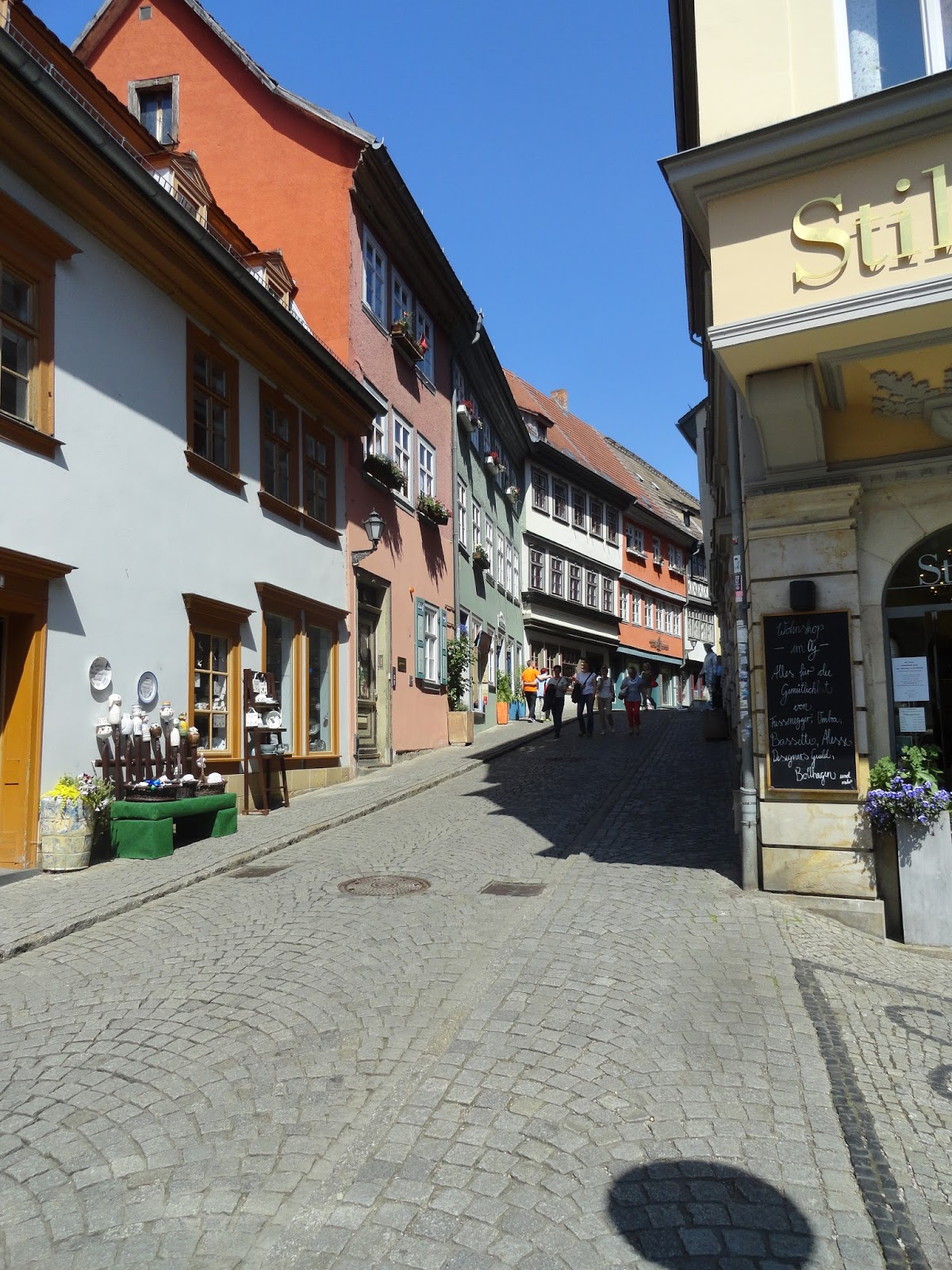
As previously mentioned, the town centre is wonderfully preserved, with narrow rows of brightly painted half-timber houses lining twisting, cobbled streets.

There's another narrow house!
Particularly fascinating for us were the narrow alleys, some of which actually felt as though you had stepped into the past. (They provided the added advantage of being free of crowds, which may have helped...)

Ok, so the graffiti isn't medieval, but who cares. Also, there's a little toy store to the right!
What makes the town centre even lovelier is that a river (the Gera) cuts through it. In many European towns, small rivers and streams like this one were moved underground at some point. This one, however, was left at the surface, and it adds a lot of beauty and character to the town centre.
We really liked that house in the background with the four balconies overhanging the river.
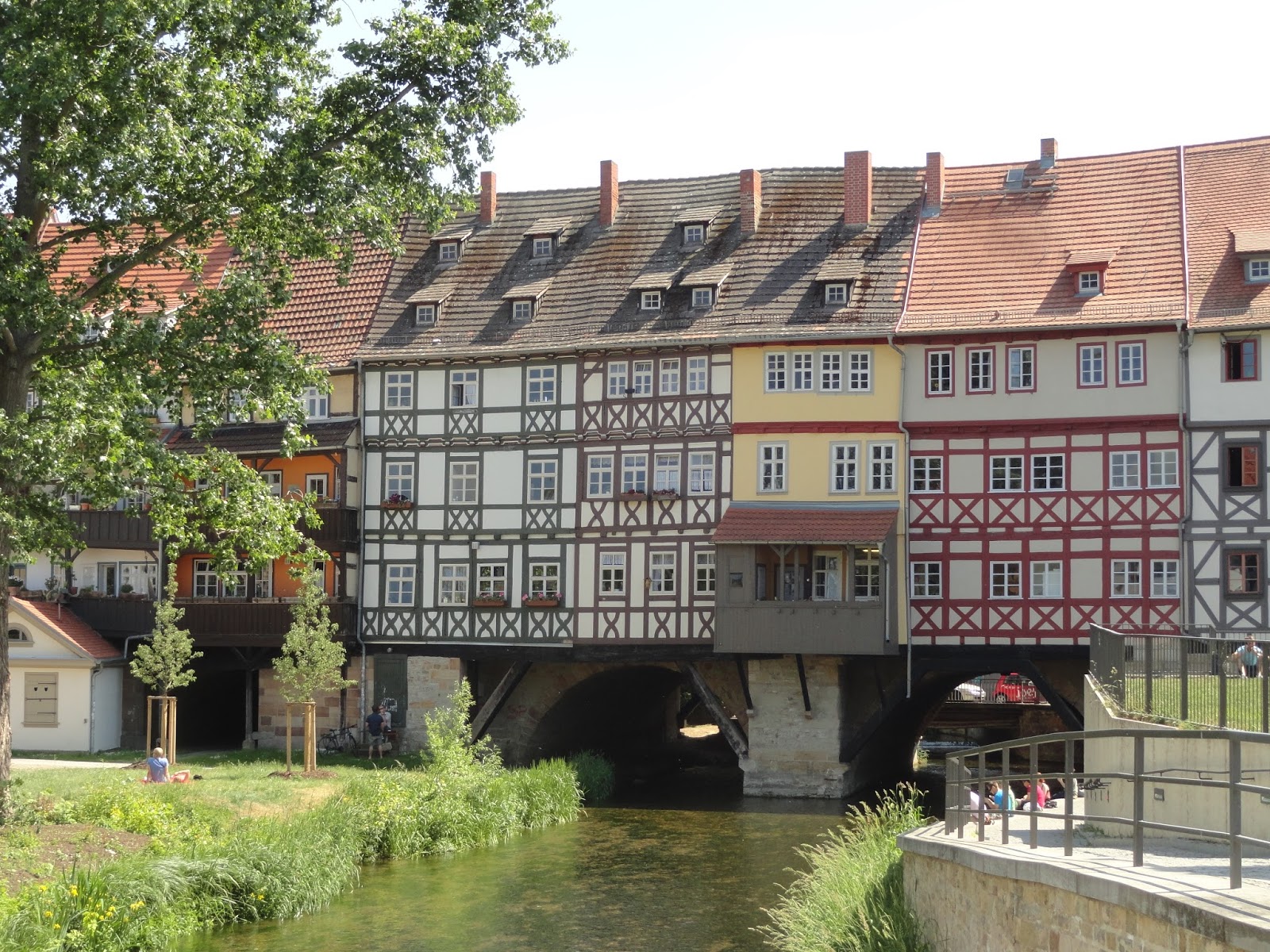
In particular, this river produces one of Erfurt’s most distinct attractions: the Krämerbrücke (Krämer-bridge, from an old German/Austrian word for merchant). This bridge is completely covered in houses and shops (hence the name) on either side of the pedestrian path that crosses it. When crossing the bridge, it is easy to miss that one is on a bridge, since the water isn’t visible. In fact, we missed it completely and had to double back and cross the bridge again before we realized where it was!


The Krämerbrücke from the outside.
However, in a carless street lined with half-timbered houses, with shops in the ground floors and living spaces in the stories above, we couldn’t help but feel as though we’d stepped back in time.
Looking over the Krämerbrücke from one end of it.
Other than this – and the novelty of knowing we were walking across a bridge when it looked like a normal street – we found the Krämerbrücke much nicer and more interesting from the outside. Beside the bridge and on the river, we found a lovely park where we spent some time and took far too many pictures.
You can see the park by the Krämerbrücke here.
It seemed like half the city was out in the park, enjoying the wonderful warm weather. We were quite happy to sneak in with them and imagine we lived there as well!

On top of being beautiful, the town is also delightfully quirky. This is a fountain of the Bremer Stadtmusikanten (Bremen city musicians) from an old fairy tale.

Bremer Stadtmusikanten as a water founatin
Giant "flower" pot, with Tristan for scale
The other big attraction in Erfurt – the Erfurt Cathedral – was our next stop. Walking there took us through further sections of the old town, so no cause for complaint! The Cathedral is a spectacular example of the late Gothic style. Gothic churches were built to be grand and impressive and this cathedral delivers, helped by the fact that it is located on a small hill above the city. We were certainly quite awed by it.
The cathedral from the front. The light was behind it when we went, so please excuse the picture quality.

One of the entrances
A picture of the inside, with the mandatory high ceilings!
The altar
A stained-glass window
There is nothing in this cathedral that isn't super ornate…just like a good gothic cathedral should be!

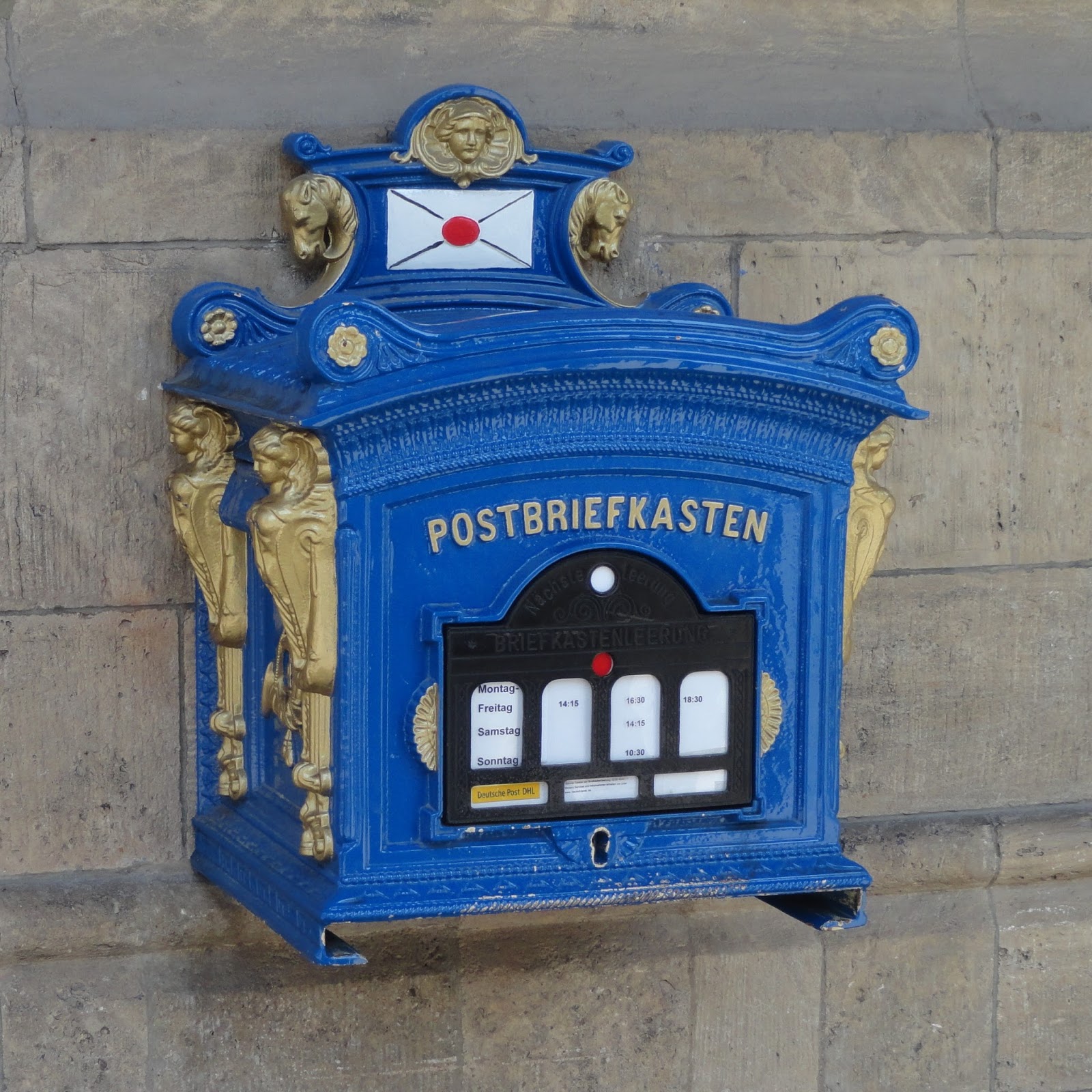
Further attractions included the city hall (with this adorable postbox outside)...

…more time wandering and sitting in parks…

and a very important stop for ice cream.

As you can see from the pictures, Erfurt is beautiful, and we couldn’t have picked a better day for city wandering. We were so charmed by the town, particularly the city centre, that we promptly started discussing moving there and opening an ice cream café. We’ll see, I suppose ;).

In this house, of course.
Next up will be our extensive adventures in the Saxony Switzerland National Park. Stay tuned!